­

SUPPORT & RESOURCES


PATIENT SUPPORT—HELP YOUR PATIENTS START AND STAY ON TRACK WITH ERZOFRI®


ERZOFRI® Assist

There are resources and support available that may be able to help patients start and stay on track with managing treatment. If you or your patients have questions about available resources, we are here to help. Please call our dedicated ERZOFRI® Assist line at 1-800-548-9765,
9:00 AM – 5:00 PM EST.

ERZOFRI® Assist can:

  • Introduce savings and access programs available for eligible patients prescribed ERZOFRI®
  • Answer common questions about taking ERZOFRI® based on the Prescribing Information
  • Refer patients to resources provided by third-party organizations that can help support them with everyday needs
  • Offer support in English, Spanish, or other languages via translation services
  • Educate patients about possible independent financial support options for patients with affordability concerns


Savings program

Help eligible patients pay as little $10 per dose*

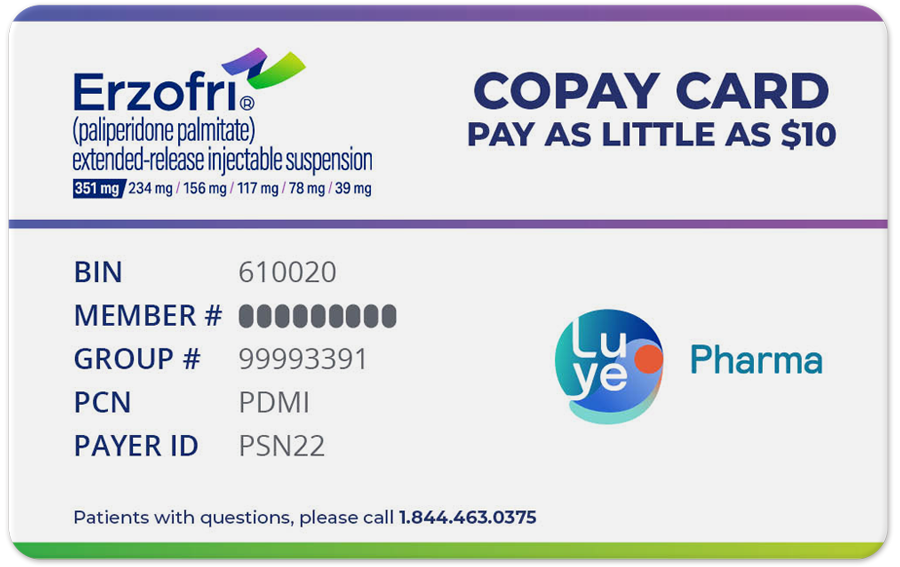
If your patients have been prescribed ERZOFRI® and have commercial insurance, they may be eligible to save on out-of-pocket expenses with the ERZOFRI® Copay Card.
Copay Card

Help your patients start saving today

  • Pay as little as $10 per dose*
  • Applies to eligible commercially insured patients

ERZOFRI® Copay Card Program Terms and Conditions

ELIGIBILITY REQUIREMENTS:

Eligibility Criteria: Subject to program limitations and terms and conditions, the ERZOFRI® Copay Card Program, also referred to simply as the ERZOFRI® Copay Card, is open to patients who have a valid prescription for ERZOFRI® and who have commercial or private insurance that covers ERZOFRI®, including state and federal plans commonly referred to as “healthcare exchange plans.” No substitutions for ERZOFRI® are permitted.

  • Eligible patients must be over the age of 18 and have commercial prescription insurance administered through a pharmacy or medical benefit plan.
  • Uninsured patients are NOT eligible to be enrolled in this copay program.
  • This copay program will pay for the out-of-pocket copay payments otherwise due from eligible patients for prescription drug coverage related to ERZOFRI®, up to the program limits.
  • This copay program does not cover any copays or other costs related to medical office visits or administration of ERZOFRI®.
  • There are no income requirements for patients to qualify for this program.
  • This offer is not valid for patients whose coverage for ERZOFRI® is paid for in whole or in part by Medicare, Medicaid, or any other federal or state healthcare program such as VA, TRICARE or DOD.
  • This program is not valid for cash-paying patients.
  • Cash Discount Cards and other non-insurance plans are NOT valid as primary insurance under this program.
  • This program is restricted to residents of the United States.
  • Patients residing in or receiving treatment in certain states may not be eligible.
  • Eligible patients may pay as little as $10 for once-monthly injections of ERZOFRI®.
  • Maximum annual benefit of $8000 per individual applies and out-of-pocket expenses may vary. Patients are responsible for costs above maximum benefit amounts.

OTHER TERMS AND CONDITIONS:

  • Patients with managed care requirements (e.g., prior authorization, step edit) must fulfill those requirements before they can be considered for enrollment.
  • To enroll in this program, patients will be required to provide personal information that includes name, home address, email address, phone number, and other information, including prescription and insurance information. This information is needed for Luye Pharma Group Ltd. and its affiliates to enroll you in the ERZOFRI® Copay Card Program. The use of your information will be governed by the Luye Pharma Group Ltd. Privacy Policy.
  • If a patient begins receiving coverage for prescriptions under any federal, state, or government healthcare program (including but not limited to Medicare, Medicaid, TRICARE, Department of Defense, or Veteran Affairs programs), the patient will no longer qualify for this program and must contact the ERZOFRI® Copay Card Program at (844) 463-0375 to stop participation in this program.
  • If the pharmacy cannot process the ERZOFRI® Copay Card, patients may still be able to receive a rebate by submitting a rebate request. Rebate requests must be submitted within 180 days of the date of service.

ADDITIONAL LIMITATIONS:

The ERZOFRI® Copay Card is intended for the benefit of patients, not their insurance plans, pharmacy benefit managers, or other third parties (“Plan Administrators”). Patients whose commercial insurance plans or plan sponsors implement the following types of programs may not be eligible for the ERZOFRI® Copay Card, or have a reduced annual maximum ERZOFRI® Copay Card benefit:

  • Programs that do not apply ERZOFRI® Copay Card payments to satisfy patient out-of-pocket cost sharing amounts (e.g., accumulator programs); or
  • Programs that require the patient’s use of the ERZOFRI® Copay Card as a condition of the plan waiving some or all of otherwise applicable patient out-of-pocket cost sharing amounts (e.g., maximizer programs).

If you believe your commercial insurance plan may have such programs in place, please call (844) 463-0375. Plan Administrators are prohibited from applying for, or assisting with, the enrollment of patients for the ERZOFRI® Copay Card benefits. The patient or their legal representative must personally enroll in the ERZOFRI® Copay Card to be eligible for benefits.

This program is not health insurance. Void if copied, transferred, purchased, altered, or traded and where prohibited and restricted by law. The program is not transferable. No substitutions are permitted. The program form may not be sold, purchased, traded, or counterfeited. Void if reproduced. The program benefit cannot be combined with any other financial assistance program, free trial, discount, prescription savings card, or other offers.

This program is managed by Paysign on behalf of Luye Pharma Group Ltd. and Luye Pharma Group Ltd. reserves the right to make eligibility determinations, to set program benefit maximums, to monitor participation, and to change, rescind, revoke, or discontinue this program at any time without notice. This program expires December 31, 2026.

If you have any questions regarding this program, your eligibility, or benefits, or if you wish to discontinue your participation, please call (844) 463-0375, Monday-Friday, 8 AM-8 PM EST, excluding holidays.

FOR THE PATIENT:

As a patient, you must not seek reimbursement for the value received from this ERZOFRI® Copay Card from any third-party payers, including a flexible spending account or healthcare savings account. Participating in this program means that you acknowledge that you are eligible for this program and agree to comply with the terms and conditions. You are also ensuring you comply with any required disclosure regarding your participation in this program to your insurance carrier or pharmacy benefit manager. The ERZOFRI® Copay Card offer must be presented along with your valid ERZOFRI® prescription and your primary insurance card to participate in this program.

Restrictions may apply. Offer subject to change or discontinuation without notice. This is not health insurance. This program is for eligible Commercially Insured Patients only. Uninsured or cash-paying patients are not eligible for this copay program.

You, the patient, may pay as little as $10 once monthly for your ERZOFRI® injections. Your maximum program assistance per prescription and annual benefit limits per patient apply and out-of-pocket expenses may vary.

FOR THE PHARMACIST:

When you apply for this program, you confirm that ERZOFRI® is being provided to an eligible commercially insured patient according to the specified terms and conditions, and the pharmacy has not, and will not, submit a claim for reimbursement under any federal, state, or other government program for this prescription.

For patients with commercial insurance, first submit the claim to the primary third-party payer. Afterward, send the remaining balance to Pharmacy Data Management, Inc. (PDMI) as a secondary payer coordination of benefits (COB) with patient responsibility and a valid other coverage code (e.g., 08). If the primary claim is denied by the insurer due to a prior authorization (PA) requirement, please initiate the PA process to assist your patient in saving on prescriptions for ERZOFRI®.

For any questions, please contact the copay support program line at (844) 463-0375, Monday-Friday, 8AM-8PM EST.

Please see full Prescribing Information for ERZOFRI®, including Boxed WARNING.

*Eligibility criteria and maximums apply.

ERZOFRI® Hospital Inpatient Free Trial Program

The Hospital Inpatient Free Trial Program provides ERZOFRI® to eligible hospitals that cannot accept Prescription Drug Marketing Act (PDMA)-compliant samples so they can provide patients their first dose of ERZOFRI® in the hospital setting, helping to facilitate seamless ongoing treatment after discharge. See more details on the program below and click the button to get started.

Icons and background images are purely decorative elements and do not convey additional meaning, content, or information to users who rely on screen readers. As such, they do not require alt text for accessibility purposes.
  • Provide patients their first dose in a hospital setting
  • Facilitate seamless ongoing treatment after discharge
Register

Already registered? Log in.

Hospital Inpatient Free Trial Program Terms and Conditions

PROGRAM TERMS AND CONDITIONS FOR THE ERZOFRI® HOSPITAL INPATIENT FREE TRIAL PROGRAM:

Program Description: The ERZOFRI® Hospital Inpatient Free Trial Program is not a marketing program, but rather a program intended to facilitate drug access to those patients admitted to the hospital and requiring immediate drug treatment which has already been prescribed by their healthcare provider (HCP). The Free Trial Program is available only to inpatient hospital pharmacies or pharmacies that certify they are supplying pharmacy services to an inpatient healthcare facility and operate as part of the inpatient hospital for which they will submit Free Trial requests and does not dispense samples for Prescription Drug Marketing Act of 1987 (PDMA).

Pharmacists can enroll through the online portal in order to participate in the Program. As part of the enrollment and before receiving any Product, the pharmacy must certify that it will abide by the Program terms and conditions, and that the Product will be used consistently with the Program terms and conditions and for qualifying patients only. Upon enrollment approval, pharmacies will receive an initial stocking order and can order replacement of Product after trial units are administered to eligible inpatients.

All participating hospitals and pharmacists must accept the following terms and conditions before they can participate in this Program.

  1. Program Product Availability: The Program Product (ERZOFRI® 351mg/2.25ml paliperidone palmitate kit, NDC 72526-0110-11) is available only to hospital pharmacies, hospital-certified pharmacies, crisis stabilization units, or acute psychiatric facilities that are supplying pharmacy services to patients receiving inpatient care (“Participating Inpatient Hospitals” or “PIHs”). Retail pharmacies are not eligible to participate in the Program.
  2. Licensing Requirements: PIHs must be validly licensed under applicable state law and do not accept Prescription Drug Marketing Act of 1987 (PDMA)-compliant samples. For avoidance of doubt, PIHs are responsible for complying with all applicable federal and state laws and licensing requirements and conditions relating to giving access to the Program Product under this Program. PIHs must notify Luye Pharma Group Ltd. promptly if they begin accepting PDMA-compliant samples.
  3. Free of Charge: Program Product is being provided free of charge to be dispensed to patients receiving inpatient care and for use consistent with Program Product’s FDA-approved indication(s) (“Qualifying Patients”). PIHs will not bill the Qualifying Patient, the Qualifying Patient’s insurance carrier, or any government healthcare program for any product dispensed as part of the Program or for any administration services in connection with Program Product. PIHs must properly report the use of free of charge Program Product where drug costs are included in a capitated rate or there is submission of a cost report or other insurer or government program reporting requirements.
  4. Prohibition on Sale: Program Product may not be sold, resold, traded, or distributed for sale.
  5. Valid Orders: Program Product will be dispensed only with a valid order from a provider licensed or authorized under state law to prescribe the product requested. The prescribing provider must be identified at the time the Program Product is ordered.
  6. Qualifying Patients: PIHs will provide Program Product only to Qualifying Patients. PIHs must ensure that prescribing providers and hospital employees understand the FDA-approved indications for the Program Product and that prescribing decisions are made in the best interest of the patient.
  7. Clinical Appropriateness: PIHs may only administer Program Product to Qualifying Patients if the prescriber has independently determined that the Program Product is clinically appropriate for that patient and that immediate onsite treatment with Program Product increases the long-term likelihood of a positive treatment outcome.
  8. Acknowledgement of Contents: Upon receipt of Program Product, PIHs must complete and return the Acknowledgement of Contents (“AOC”) form, confirming the contents of the delivery. The AOC will be included with the shipment. AOCs must be returned or the PIH faces exclusion from the Program. Participating hospitals have the option of completing their AOCs through the ordering portal as an alternative to faxing using the number provided on the AOC. In the event of any discrepancy in Program Product orders and deliveries, Hospitals agree to assist Luye Pharma Group Ltd., or its third-party agents with an investigation into the occurrence.
  9. Trial Units: Hospitals will be allowed a maximum of one hundred twenty (120) units of Program Product every six (6) months. Pharmacists may receive the minimum of one (1) product unit up to the maximum of five (5) product units per order. Any order in excess of five (5) total product units will be rejected.
  10. Tracking and Controls: PIHs must have adequate controls to track utilization of Program Product by each patient and must establish adequate controls to ensure that Program Product is appropriately segregated and tracked to ensure compliance with these terms and conditions.
  11. Monitoring: PIHs will conduct certain monitoring to detect irregularities, such as failure to comply with the terms and conditions of participation or to submit forms acknowledging receipt of Program Product.
  12. No Obligation: PIHs, prescribing providers, and patients, as applicable, are under no obligation to prescribe, continue using, or recommend ERZOFRI® products, including Program Product, as a condition of receiving any Program Product.
  13. Labeling: Program Product is commercially labeled as trade product and not labeled as samples.
  14. Program Termination: The Program terminates on December 31, 2026. However, Luye Pharma Group Ltd. reserves the right to terminate the Program at any earlier date. Luye Pharma Group Ltd. will endeavor to provide notice of any such early termination as early as possible. At any time, a PIH may terminate its participation in the Program by calling 1-833-351-7111.
  15. Reporting Requirements: Program registrant’s name and the free trial disbursements may be reported as required by state or federal law. Once reported, this information may be made publicly available. PIHs are responsible for obtaining any necessary consents from the program registrants for the disclosure of personal information.
Icon Minus
Icon Plus

INDICATIONS AND USAGE:

INDICATIONS AND USAGE: ERZOFRI® (paliperidone palmitate) extended-release injectable suspension for intramuscular use is an atypical antipsychotic indicated for the treatment of:

  • schizophrenia in adults
  • schizoaffective disorder in adults as monotherapy and as an adjunct to mood stabilizers or antidepressants

IMPORTANT SAFETY INFORMATION FOR ERZOFRI

WARNING: INCREASED MORTALITY IN ELDERLY PATIENTS WITH DEMENTIA-RELATED PSYCHOSIS

Elderly patients with dementia-related psychosis treated with antipsychotic drugs are at an increased risk of death. ERZOFRI is not approved for use in patients with dementia-related psychosis.

CONTRAINDICATIONS

ERZOFRI is contraindicated in patients with known hypersensitivity to paliperidone, risperidone, or to any excipients in ERZOFRI.

WARNINGS AND PRECAUTIONS

  • Cerebrovascular Adverse Reactions, Including Stroke, in Elderly Patients with Dementia-Related Psychosis: Increased incidence of cerebrovascular adverse reactions (e.g., stroke, transient ischemic attacks) including fatalities.
  • Neuroleptic Malignant Syndrome (NMS): NMS, a potentially fatal symptom complex, has been reported in association with antipsychotic drugs. Manage with immediate discontinuation and close monitoring.
  • QT Prolongation: Avoid use with drugs that also increase QT interval and in patients with risk factors for prolonged QT interval and patients with a history of cardiac arrhythmias.
  • Tardive Dyskinesia (TD): TD, a syndrome consisting of potentially irreversible, involuntary, dyskinetic movements, may develop in patients treated with antipsychotic drugs. ERZOFRI should be prescribed in a manner that is most likely to minimize occurrence of TD. Chronic antipsychotic treatment should generally be reserved for patients: (1) who suffer from a chronic illness that is known to respond to antipsychotic drugs and (2) for whom alternative, equally effective, but potentially less harmful treatments are not available or appropriate. In patients who require chronic treatment, use the lowest dose and shortest duration of treatment producing a satisfactory clinical response. Periodically reassess the need for continued treatment.

    If signs and symptoms of TD appear in a patient treated with ERZOFRI, drug discontinuation should be considered. However, some patients may require treatment with ERZOFRI despite the presence of the syndrome.

  • Metabolic Changes: Atypical antipsychotic drugs have caused metabolic changes, including hyperglycemia, diabetes mellitus, dyslipidemia, and body weight gain that may increase the cardiovascular/cerebrovascular risk.
    • Hyperglycemia and Diabetes Mellitus: Monitor for hyperglycemia/diabetes mellitus, dyslipidemia, and weight gain. Patients with an established diagnosis of diabetes mellitus who are started on atypical antipsychotics should be monitored regularly for worsening glucose control. Patients with risk factors for diabetes mellitus (e.g., obesity, family history of diabetes) who are starting treatment with atypical antipsychotics should undergo fasting blood glucose testing at the beginning of treatment and periodically during treatment. Any patient treated with atypical antipsychotics should be monitored for symptoms of hyperglycemia including polydipsia, polyuria, polyphagia, and weakness. Patients who develop symptoms of hyperglycemia during treatment with atypical antipsychotics should undergo fasting blood glucose testing. In some cases, hyperglycemia resolved when the atypical antipsychotic was discontinued; however, some patients required continuation of anti-diabetic treatment despite discontinuation of the suspect drug.
    • Dyslipidemia: Undesirable alterations in lipids have been observed in patients treated with atypical antipsychotics.
    • Weight Gain: Weight gain has been observed with atypical antipsychotic use. Clinical monitoring of weight is recommended.
  • Orthostatic Hypotension and Syncope: Paliperidone may induce orthostatic hypotension and syncope in some patients because of its alpha-adrenergic blocking activity. Use ERZOFRI with caution in patients with known cardiovascular disease (e.g., heart failure, history of myocardial infarction or ischemia, conduction abnormalities), cerebrovascular disease, or conditions that predispose the patient to hypotension (e.g., dehydration, hypovolemia, and treatment with antihypertensive medications). Monitoring of orthostatic vital signs should be considered in patients who are vulnerable to hypotension.
  • Falls: Somnolence, postural hypotension, motor and sensory instability have been reported with the use of antipsychotics, including paliperidone palmitate, which may lead to falls, and consequently, fractures or other fall-related injuries.
  • Leukopenia, Neutropenia, and Agranulocytosis: In clinical trial and/or postmarketing experience, events of leukopenia and neutropenia have been reported temporally related to antipsychotic agents, including once-a-month paliperidone palmitate. Agranulocytosis has also been reported. Possible risk factors for leukopenia/neutropenia include pre-existing low white blood cell count (WBC)/absolute neutrophil count (ANC) and history of drug-induced leukopenia/neutropenia. In patients with a history of a clinically significant low WBC/ANC or a drug-induced leukopenia/neutropenia, perform a complete blood count (CBC) frequently during the first few months of therapy. In such patients, consider discontinuation of ERZOFRI at the first sign of a clinically significant decline in WBC in the absence of other causative factors. Monitor patients with clinically significant neutropenia for fever or other symptoms or signs of infection and treat promptly if such symptoms or signs occur. Discontinue ERZOFRI in patients with severe neutropenia (absolute neutrophil count <1000/mm3) and follow their WBC until recovery.
  • Hyperprolactinemia: Paliperidone elevates prolactin levels and the elevation persists during chronic administration. Paliperidone has a prolactin-elevating effect similar to that seen with risperidone, a drug that is associated with higher levels of prolactin than other antipsychotic drugs.  Long-standing hyperprolactinemia, when associated with hypogonadism may lead to decreased bone density in both female and male subjects.
  • Potential for Cognitive and Motor Impairment: Somnolence, sedation, and dizziness were reported as adverse reactions in subjects treated with another once-a-month paliperidone palmitate extended-release injectable suspension. Antipsychotics, including ERZOFRI, have the potential to impair judgement, thinking, or motor skills. Patients should be cautioned about performing activities requiring mental alertness, such as operating hazardous machinery or operating a motor vehicle, until they are reasonably certain that paliperidone therapy does not adversely affect them.
  • Seizures: Like other antipsychotic drugs, ERZOFRI should be used cautiously in patients with a history of seizures or other conditions that potentially lower the seizure threshold.
  • Dysphagia: Esophageal dysmotility and aspiration have been associated with antipsychotic drug use. ERZOFRI and other antipsychotic drugs should be used cautiously in patients at risk for aspiration.
  • Priapism: Drugs with alpha-adrenergic blocking effects have been reported to induce priapism.
  • Disruption of Body Temperature Regulation: Disruption of the body’s ability to reduce core body temperature has been attributed to antipsychotic agents. Appropriate care is advised when prescribing ERZOFRI to patients who will be experiencing conditions which may contribute to an elevation in core body temperature, e.g. exercising strenuously, exposure to extreme heat, receiving concomitant medication with anticholinergic activity, or being subject to dehydration.

ADVERSE REACTIONS

The most common adverse reactions (incidence ≥5% and occurring at least twice as often as placebo) were injection site reactions, somnolence/sedation, dizziness, akathisia, and extrapyramidal disorder.

USE IN SPECIFIC POPULATIONS

Pregnancy Exposure Registry: There is a pregnancy exposure registry that monitors pregnancy outcomes in women exposed to atypical antipsychotics, including ERZOFRI, during pregnancy. Healthcare providers are encouraged to register patients by contacting the National Pregnancy Registry for Atypical Antipsychotics at 1-866-961-2388 or online at http://womensmentalhealth.org/clinicaland-research-programs/pregnancyregistry/.

Risk Summary: Neonates exposed to antipsychotic drugs during the third trimester of pregnancy are at risk for extrapyramidal and/or withdrawal symptoms following delivery. Overall, available data from published epidemiologic studies of pregnant women exposed to paliperidone have not established a drug-associated risk for major birth defects, miscarriage, or adverse maternal or fetal outcomes. There are risks to the mother associated with untreated schizophrenia and with exposure to antipsychotics, including ERZOFRI, during pregnancy.

Lactation: Infants exposed to ERZOFRI through breastmilk should be monitored for excess sedation, failure to thrive, jitteriness, and extrapyramidal symptoms (tremors and abnormal muscle movements).

Fertility: Treatment with ERZOFRI may result in an increase in serum prolactin levels, which may lead to a reversible reduction in fertility in females of reproductive potential.

Renal Impairment: Use of ERZOFRI is not recommended in patients with moderate or severe renal impairment (creatinine clearance <50 mL/min).

Patients with Parkinson’s Disease or Lewy Body Dementia: Patients with Parkinson’s Disease or Dementia with Lewy Bodies can experience increased sensitivity to ERZOFRI. Manifestations can include confusion, obtundation, postural instability with frequent falls, extrapyramidal symptoms, and clinical features consistent with neuroleptic malignant syndrome.

Please see full Prescribing Information for ERZOFRI® including BOXED WARNING.